

NEWS / TOPICSニュース&トピックス
- HOME
- NEWS / TOPICS
- NEWS
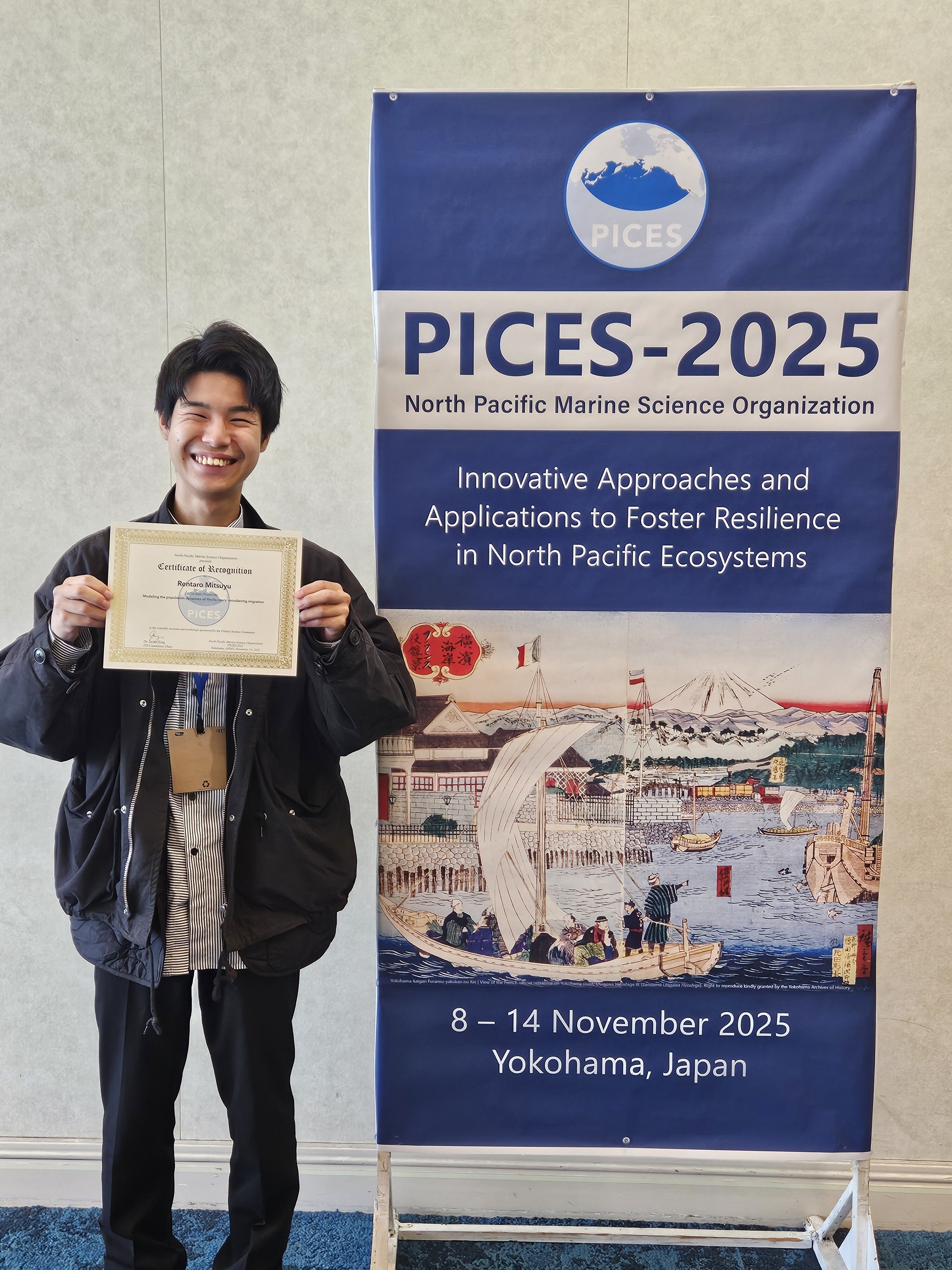
- [Awards and Commendations] Rentaro Mitsuyu (1st year master's student) received the Best ECOP Poster Presentation Award by the Fishery Science Committee at the North Pacific Ocean Science Organization (PICES) 2025 Annual Meeting.
[Awards and Commendations] Rentaro Mitsuyu (1st year master's student) received the Best ECOP Poster Presentation Award by the Fishery Science Committee at the North Pacific Ocean Science Organization (PICES) 2025 Annual Meeting.
At the North Pacific Ocean Sciences Organization (PICES) 2025 Annual Meeting , held in Yokohama, Kanagawa Prefecture, from Sunday, November 8th to the 14th, November 2025 , graduate student Rentaro Mitsuyu was awarded the Best ECOP (Early Career Ocean Professional) Poster Presentation Award by the Fishery Science Committee .
【Winner】
Rentaro Mitsuyu ( 1- year PhD program in Marine Management Policy, Graduate School of Marine Science and Technology)
[Title of award-winning research]
Modeling the population dynamics of Pacific saury considering migration
[Details of award-winning research]
Pacific saury migrate widely throughout the North Pacific throughout the year. It is known that the distribution of spawning seasons affects recruitment, and the distribution of feeding seasons affects growth. However, these aspects are not fully considered in current resource assessments. Quantitatively understanding the spatiotemporal distribution of Pacific saury is important for accurately understanding the status of the resource. Based on the knowledge that Pacific saury movements are significantly affected by sea surface temperature, this study constructed a spatiotemporal model that explicitly incorporates the relationship between migratory behavior and sea surface temperature. This model probabilistically represents movements in response to sea surface temperature and data observations, allowing for natural handling of migration uncertainty. Furthermore, simulation experiments were conducted to estimate the model parameters using both maximum likelihood estimation using Laplace approximation and Bayesian estimation using MCMC. Results confirmed that under experimental conditions, both methods were able to reproduce Pacific saury distributions with an error of approximately 5%. This method may also be applicable to other fish species that migrate in response to the marine environment. We also believe that in the future, this data can be used as a basis for quantitatively evaluating the effectiveness of spatiotemporal resource management methods such as closed seasons and areas.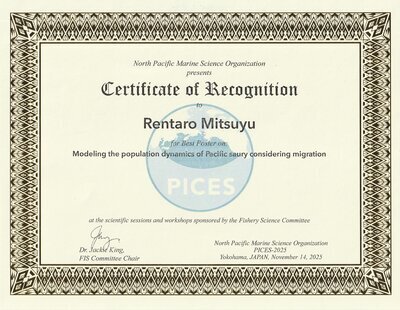
<Related links>
PICES-2025 Annual Meeting