OUR OQEANOUS STUDENTS
- HOME
- OUR OQEANOUS STUDENTS
- STP
- STP Report (KMOU - Aug 2026)
Short Term Program
STP Report (KMOU - Aug 2026)
2026.10.15
Course of Marine Life Science of TUMSAT
4th year of Undergraduate
H.O.
Why I Applied for STP
I applied for STP because I was interested in graduate school and research environments in other countries. When I saw the information about the program, I wanted to learn what kind of research graduate students and professors do overseas and what their university life is like.I had also never been to Korea before, so I wanted to experience Korean culture and see the atmosphere of the country for myself. I had studied abroad in Iceland before, but Korea has a very different culture and environment. I was also interested in studying and spending time with students from other universities in Asia.
During the first week, we took online lectures. We were divided into groups of about six students, and each group was given a research paper written by a professor at KMOU. Our group read a paper about the concentration of methylmercury in shellfish collected in Korean waters. We had enough time to read one paper carefully, and we could ask questions directly to the professor who wrote it. I do not usually have a chance to discuss a research paper with its author, so this was very interesting for me. However, most of the communication in our group was done through chat, so we had fewer chances to speak English directly than I had expected. I felt that it would have been better to have more time to talk with each other and exchange ideas by speaking. I also noticed some differences in the way students joined the classes. For example, some students attended the lectures while they were traveling or moving somewhere. This felt quite different from university classes in Japan. It made me realize that the way I think students should attend classes is not always the same in other countries.
In Japan, we joined a training program at IDEA Consultants, Inc., an environmental consulting company. The part I found most interesting was learning about the honey produced by the company. The person who came up with the idea explained why they started making honey, the story behind the product, the package design, hygiene management, and their plans for the future. Since I study food science, I was interested not only in the food itself but also in how a product is planned and sold. It was interesting to hear how people think about a product from different points of view. I also tried beekeeping for the first time in my life. This was a new experience for me, and it made me think about how knowledge from university can be used in society.
Field Trip in Korea
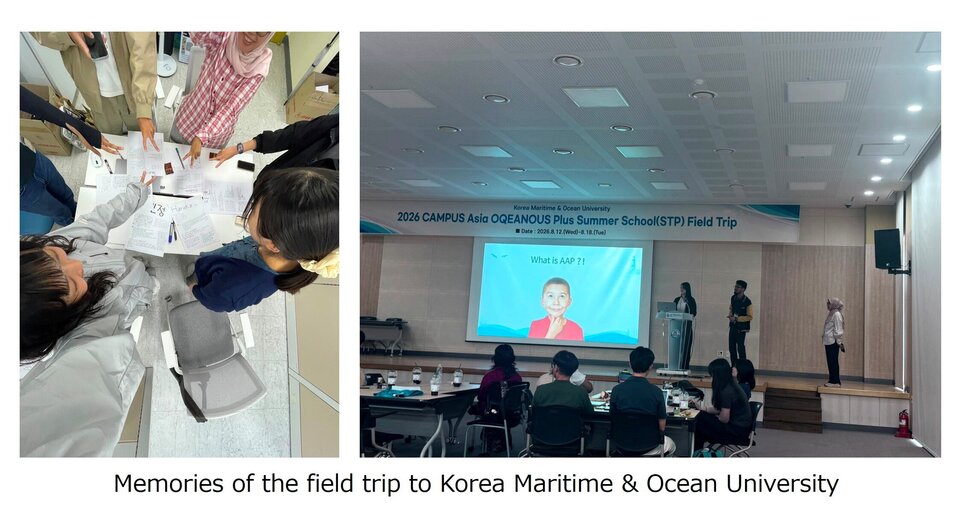
After the online lectures, we visited KMOU in Busan and joined a face-to-face program for about one week. At KMOU, we visited the campus and laboratories and learned about the research being done there. We also visited research institutes and facilities related to the ocean and fisheries. Through these visits, I learned more about marine and fisheries research in Korea. One activity that I especially remember was making a new international education program in a group and presenting it in front of professors and students. Our group created a four-week program called the "Asian Academic Program," or AAP. The group work was not easy. Everyone had a different level of English, and we had to create a completely new program from the beginning. First, we needed to make sure that everyone understood the ideas in the same way. Sometimes one explanation was not enough, so we asked questions again or explained the same idea in different words. Sometimes people also used translation apps. Of course, if everyone could use English at a high level, the discussion would be faster. However, I also felt that trying different ways to understand each other is an important part of international communication.
I was surprised that many international students knew Japanese words. Some of them could even have simple conversations in Japanese. I heard that some students started learning Japanese because they were interested in anime and other parts of Japanese culture. Even though we were in Korea, Japanese sometimes helped us communicate, which was interesting to me. The other students also taught me some Korean words, and teaching each other our languages became one way of getting closer. It was also my first time spending a lot of time with Muslim students. I already knew that Muslims pray at certain times and that many of them do not eat pork or drink alcohol. However, spending time together helped me understand that these things are part of their daily life. For example, different meals were prepared for them, and some students left the group when it was time to pray. There were also some differences in the accommodation because of religious and lifestyle needs. I felt that actually spending time together helped me understand these customs much better than only learning about them in class.
After joining this program, I felt that I should learn more not only about different cultures and lifestyles but also about the history between countries. I think it is difficult to really understand another culture by only knowing things on the surface. Learning about the history and society behind the culture is also important when communicating with people from other countries.