
CAMPUS LIFE
- HOME
- CAMPUS LIFE
- Practical Information for Exchange Students
Practical Information for Exchange Students
Public Transportation
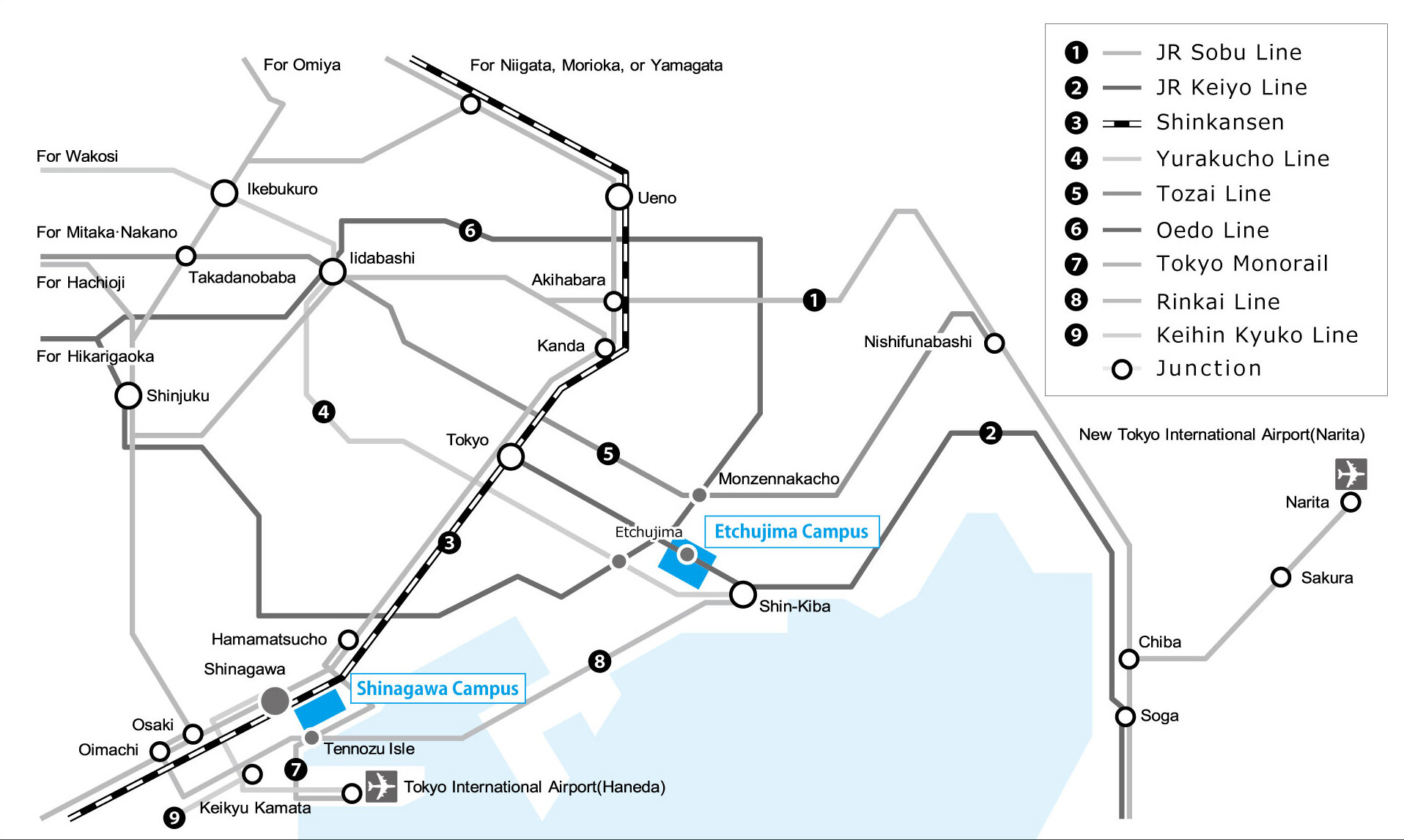
It takes about 15 minutes on foot from TUMSAT to Shinagawa Station and Tennoz Isle Station.
Shinagawa Station is an increasingly important transportation hub in central Tokyo (it takes about 11 minutes to Tokyo Station by Yamanote or Keihintohoku Line), with train services to and from Tokyo's two international airports (Haneda and Narita) and Shinkansen Trains to and from Nagoya, Kyoto, Shin-osaka, Shin-kobe, Okayama, Hiroshima and Hakata. It is also an important commuter hub connecting Tokyo and neighboring prefectures, as well as the stop of JR Yamanote Loop Line. Keikyu Line Shinagawa station to Haneda Airport (approximately 22 minutes). JR Shinagawa station to Narita Airport (approximately 60 minutes by express). Tennoz Isle Station is served by the Tokyo Monorail (15 minumtes to Haneda Airport) and the Rinkai Line.
Suica/PASMO (e-money)
Suica and PASMO (prepaid e-money cards) are convenient for transportation and shopping in kanto-area(around Tokyo). When boarding a train, there is no need to buy a ticket from a vending machine each time; simply touch and go at the ticket gate and the fare is automatically deducted from your Suica or PASMO. You can also purchase things from vending machines, and convenience stores, as e-money. Suica and PASMO are issued by different railroad companies. Both Suica and PASMO allow you travel around by not only trains but subways and buses.
Suica / PASMO can be topped up at station ticket vending machines or at convenience stores, instantly.
You can use it as a physical card or connect it to your credit card to add it to your smartphone as Mobile SUICA or Mobile PASMO.
How to add SUICA/PASMO to your smart phone
Mobile PASMO (First choose Apple/Android, then choose language)
General Information on Climate of Japan
Japan has four seasons, and the climate varies from subarctic in the north to subtropical in the south. Conditions differ between the Pacific Ocean side and the Sea of Japan side.
Northern Japan has warm summers and very cold winters, with heavy snowfall on the Sea of Japan side and in mountainous areas. Eastern Japan experiences hot and humid summers, cold winters, and heavy snowfall on the Sea of Japan side and in mountainous areas. Western Japan has hot and humid summers with temperatures above 35℃ and moderate cold winters. Okinawa and Amami have a subtropical maritime climate.
Japn's climate is experiencing a long-term rise in average temperatures, warming at a faster pace than the global average. As a result, the number of extreme heat days and tropical nights is increasing, while the number of winter days and snowfall amounts are decreasing. Rainfall patterns are also changing, with an increase in days featuring intense rain exceeding 50 mm per hour and heavy rainfall, heightening the risk of landslides and flooding caused by torrential downpours.
Climate change information from Japan Meteorological Agency
Climate of Tokyo
The hottest season is early August, and the coldest season is late January. The temperature difference between the hottest and the coldest months is about 23℃(2025). The average summer temperature is 28.2℃(Tokyo, July to September 2025) and the average humidity is 76% (Tokyo, July to September 2025). The average winter temperature is 7.1℃ (Tokyo, December 2024 to February 2025) and the average humidity is 50% (Tokyo, December 2024 to February 2025) .
*Based on Japan Meteorological Agency HP
Rainy and humid climate is a characteristic of Japan's climate. The average humidity throughout Japan is 60-70% per year. Hot and humid weather with 75% above continues in summer months.
Language
Official language is Japanese. It is divided into a large number of dialects, and Tokyo dialect is considered closer to the standard Japanese. In public spaces, signage in Japanese, English, Chinese and Korean is increasingly common.
Pictograms, which are intuitively understandable regardless of language, have also become more widespread in recent years.
Locations
Student Visa and Residence Permit
To study at Tokyo University of Marine Science and Technology (TUMSAT) , you must first apply through your home university's coordinator and obtain admission to TUMSAT.
TUMSAT will then apply for a Certificate of Eligibility (COE) on your behalf.
Issuing a COE takes one to three months. TUMSAT will forward COE (issued as a form of email) with attachment of official acceptance letter from TUMSAT to the student directly.
Next, submit above two documents and other required documents to the Japanese embassy, consulate or visa center in your country of residence (varies by country) to apply for a student visa. This is the basic procedure.
Students are responsible for investigating the specific procedures and locations for applying for a student visa in their home country.
Residence management system
【IMPORTANT】
Please check the website for the ward where you live before you come to Japan to determine if there are any documents you need to bring with you from your home country to register as a resident.
Echujima Campus: Koto-ward
Shinagawa Campus: Minato-ward
Foreigners who stay in Japan for more than three months (mid- to long-term residents) are issued a resident card. It is commonly referred to as a Zairyu card and handed to you during the immigration inspection upon entering Japan.
Residence records
The Residence Record includes and certifies the address, the head of household (the person who represents the household and financially supports the household) and family composition (all persons financially supported by the household, not just those living together). Foreign nationals (resident card holders, etc.) are recorded in the same manner. If you need a copy of your residence certificate, please bring your resident card to the municipal office, and request it. Fees apply. International students residing in student dormitories are automatically registered as the head of a single-person household.
Orientation Meeting
Orientation meeting will be held on campus. We will share the detailed information afterwards. Orientation meeting may be conducted as on-demand video..
Communication Service
International Telephone Calls
KDDI is the most commonly used for international calls. Alternative companies include SoftBank, NTT Communications etc. As with domestic calls, there is a slight difference in rates among companies. ALL offer discounted nighttime and holiday rates.
The prefix codes and contact numbers for these companies are as follows:
| Main Telephone Companies | Prefix | Contact Numbers(toll-free) |
|---|---|---|
| KDDI | 001 | Tel: 0057 |
| SoftBank | 0061 | Tel: 0120-85-0061 |
| NTT Communications | 0033 | Tel: 0120-506506 |
How to Make an Overseas Call
Dial
Telephone Company Prefix + 010 + Country Code + Area Code (without first 0) + Telephone Number in the correct order.
Cellular Phones, Smart Phones
Mobile phone companies
Major carriers (MNO) that own their own communication infrastructure, and budget SIMs and sub-brands that lease lines from major carriers to provide services. The four major carriers are NTT Docomo, au, SoftBank, and Rakuten Mobile, each differing in coverage area, quality, pricing plans, and unique services.
NTT docomo
- Tel: 0120-005-250
English, Chinese, Spanish, Portuguese: 9:00 a.m.-8:00 p.m. - Website
SoftBank
- Tel: 0800-919-0157
press 8 to hear options in English - Website
KDDI (au)
- Tel:
English 0120-959-472 (Toll Free)
Chinese 0120-959-476 (Toll Free)
Korean 0120-959-478 (Toll Free) - Website
Rakuten mobile
- Tel:
0800-805-0805
English; 9:00 a.m.-5:00 p.m. - Website
SIM Card
There are various SIM cards available for foreign visitors. You can purchase them online before arriving in Japan or at the airport.
WI-FI
Student Wi-Fi is available on campus, but if you want Wi-Fi in your dorm room, you'll need to get your own router. Monthly contracts that can be canceled when you return home are convenient. Off-campus, you may be able to use free Wi-Fi provided by local governments, public facilities, convenience stores, and cafes. When using these services, choose networks where the provider is clearly identified for security reasons.
Cellular Phone Rental Service
There are many companies providing rental services of cellular phones that can be used in Japan and overseas. The companies above and their group companies also offer such services. Since the fees and application systems differ depending on the company, you should confirm the details with each company. In the arrival hall at airports, some companies rent cellular phones without a reservation.
Public Telephones
Public telephones can be used with 10-yen coins, 100-yen coins or a prepaid telephone card. Telephone cards may be available for purchase at convenience stores. Public telephones that with a gold line can make international calls. Emergency calls to police (110) and fire (119)/ ambulance services (119) do not require coins or phone cards. The number of public telephones has decreased due to the widespread adoption of mobile phones and Wi-Fi. During large-scale emergencies, public phones are convenient when mobile phones become difficult to connect.
Post-Cargo-Courier Service (Mail and Takkyubin)
Post Offices
Besides handling all types of mail, post offices also provide banking and insurance services. Most post offices are open from 9am to 5pm for mail and from 9am to 4pm for insurance and savings transactions. Although windows are usually closed on Saturdays, Sundays, and national holidays, one post office in each district is open on these days as well. Please ask at your local post office for details. In addition to post offices, stamps and postcards are available at convenience stores. For mails that require signature (seal or stamp), such as parcels and registered mail, the mail carrier will take the mail back to the post office and leave a delivery notice instead if you are not at home. You can arrange for re-delivery, but if you wish to receive it from post office, you must bring the delivery notice, your residence card or other identification, and your personal stamp (hanko) to the designated post office.
Overseas Courier Services
In addition to post offices, there are also private courier companies that deliver letters and parcels not only in Japan but also overseas.
<Examples of mailing small parcel>
International Yamato Transport
International parcel: "EMS" by post Office
Currency
Japanese national currency is Japanese Yen (JPY). There are four kinds of bills (10,000 yen, 5,000 yen, 2,000 yen, 1,000 yen) and six kinds of coins (500 yen, 100 yen, 50 yen, 10 yen, 5 yen, 1 yen) used. Official exchange rates can be obtained from the Bank of Japan. New bills have been in circulation since July 2024, but old bills remain valid, so two types of bills are currently in circulation.
Banking Services and Credit Cards(Life in Japan)
Opening a Bank Account
Opening a bank account makes it convenient to perform various transactions, such as receiving living expenses and paying utility bills. When opening an account, you will be asked to present identification to verify your identity, so please bring your residence card, passport or other forms of identification, as well as your personal seal (hanko). Some banks allow you to open an account with your signature, so it is better to ask in advance.
For your reference, there is a post office with a Japan Post Bank near TUMSAT, so it might be convenient to open account there. (website) Please check the website before coming to Japan to see if there are any documents to bring from your own country.
You can also withdraw cash with your credit card or cash card issued in foreign countries at Japan Post ATMs. (website). This is one of the options before opening your bank account.


There are strict requirements thus it is difficult for foreigners to open a new credit card in Japan, so it is better to bring a credit card from your home country.
Credit card
"VISA" and "Mastercard" and "JCB" are the major credit cards accepted in Japan.
