OUR OQEANOUS STUDENTS
- HOME
- OUR OQEANOUS STUDENTS
- STP
- STP Report (KMOU - Aug 2026)
Short Term Program
STP Report (KMOU - Aug 2026)
2026.10.15
Course of Marine Environmental, Graduate School of TUMSAT
2nd year of Master's Program
Y.H.
Reasons for Applying to the STP
Although I became interested in studying abroad after taking a course overseas whilst an undergraduate, I did not have the opportunity to take part in a long-term study abroad program. Whilst searching for a short-term overseas experience program, I came across this one and decided I definitely wanted to take part, so I applied.
About the Online Lecture
Prior to the field trip, we attended an online lecture conducted in English. Working in groups, we read assigned research papers and prepared questions for the authors regarding points we found unclear or topics that piqued our interest. Since the paper I was assigned was closely related to my major, I was able to understand it fairly easily; however, papers in other fields contained many unfamiliar technical terms, and I struggled to comprehend them based solely on the English explanations. Nevertheless, because the class covered literature from a wide range of fields, my knowledge expanded into areas I had not previously known, making it a very educational experience.
About the IDEA Training Program
We had the opportunity to tour IDEA Consultants, Inc.'s Training Center and Institute of Environmental Ecology. Through lectures on the company's business activities and group exercises, we were able to deepen our understanding of the company's cutting-edge technologies and operations. While I had originally viewed the company primarily as an environmental consulting firm, I was greatly surprised and enlightened to learn that it operates a diverse range of businesses, including beekeeping.
About the In-Person Program (Field Trip) in South Korea
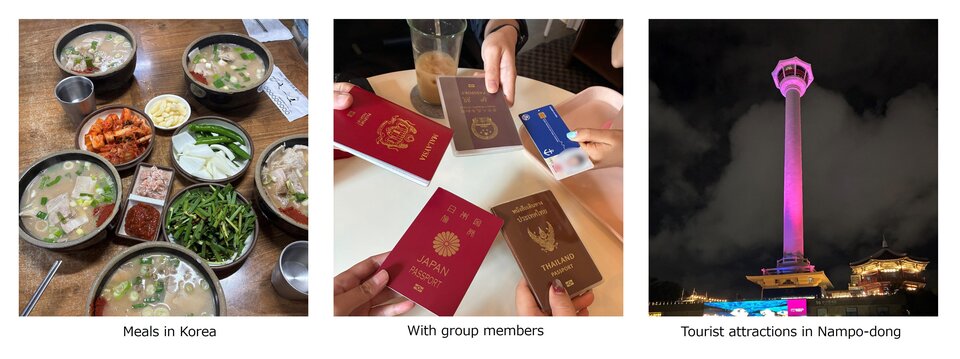
We were able to tour university facilities and experience Korean culture, spending a very intense and fulfilling week. The museums and public squares we visited featured many exhibits and structures related to Japan, allowing us to deeply appreciate the cultural and historical ties between Japan and Korea. Additionally, Korean students taught me that the old novels on display in museums are taught in Korean elementary schools, and that the samgyeopsal I had imagined was actually adapted to Japanese tastes--all of which helped me gain a deeper understanding of Korean culture.
Interaction with Students from Other Universities
During the program, we mainly carried out activities such as fieldwork in groups of five to six people. Many students in my group were interested in Japan; they showed me photos from their trips to Japan, and we had lively talked about their favorite Japanese anime and manga. It made me truly happy to see them take an interest in my country. Since English wasn't everyone's first language, things were a bit awkward at first, but as we taught each other greetings and customs from our respective home countries, we naturally grew closer. We often had free time in the evenings, which we spent going out to eat together or preparing for our presentations. I am especially grateful to the students from Korea, who not only showed me around tourist spots but also provided thoughtful support with everyday life.
I also became close with the student I shared a dorm room with, and every night before bed, we'd talk about the day's events and share recommendations for funny videos. Even after the program ended, that friend came to Japan on vacation, and we were able to continue our friendship by enjoying sightseeing in Tokyo together--I'm so happy we've stayed in touch.
Changes in My Perspective After Participating
Before participating, I had the misconception that I had to speak English perfectly while studying abroad, but I realized that the willingness to communicate is far more important than speaking with flawless grammar or pronunciation. I had always felt insecure about my English, but when I tried to speak without giving up, everyone around me listened warmly and made an effort to understand me. Through this experience, the barrier to communicating in English lowered, and I gained the confidence to express myself in my own words.
Furthermore, I was able to engage deeply with the cultures and histories of each country, and it was a highly stimulating learning experience that allowed me to broaden my values in an environment different from Japan's.