
OUR OQEANOUS STUDENTS
- HOME
- OUR OQEANOUS STUDENTS
- IJP
- IJP Report (TUMSAT October 2025 - March 2026)
International Joint Program
IJP Report (TUMSAT October 2025 - March 2026)
2026.05.07
Graduate School of Kasetsart University
Course of Marine Science
Second Year of Master's Program
W. K.
|
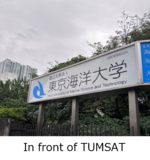
[Motivation for applying] During my undergraduate studies in Marine Science course, I developed a keen interest in marine biology and crustacean taxonomy. Studying abroad had always been a lifelong goal, and the OQEANOUS Plus Program at TUMSAT provided the perfect opportunity to pursue research in a country renowned for its baseline studies in diversity. Suddenly, I found out that registration of OQEANOUS Plus Programs was an exchange program at TUMSAT that specific on marine science, so I applied on it right away to encounter new experiences such as knowledge, research interests from students from other countries. Furthermore, I believed that studying abroad would not only deepen my knowledge through academics, but also allow me to experience Japanese culture, including language, culture, and food. |
 |
|
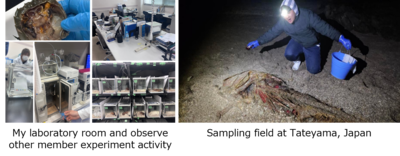
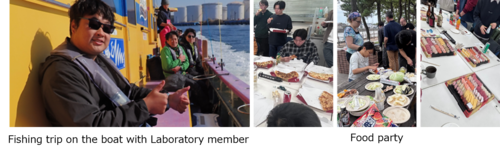
[Life in Laboratory] I joined Chemical ecology laboratory. Although this field differs from my previous focus on biodiversity, it offered a unique opportunity to learn about chemical compounds in crustaceans. I gained hands-on experience by observing experiments such as the dissection of seaweed crabs and the cultivation of spiny lobsters. During my time in the laboratory, I had the opportunity to attend seminars. I was able to listen to various research presentations from local and international students, which highlighted the ecological importance of marine chemical compounds in organisms. It was also a great opportunity to share my own field of study with other members. Additionally, I participated in field sampling for crabs in the Tateyama area. It was truly impressive to observe rocky shore ecology during the night, when many invertebrates such as shrimp, crabs, and sea hares emerge from hiding. Helping my lab members find crabs was a highlight that related to my own studies and was a very enjoyable experience. Moreover, the laboratory organized many relaxing activities, such as food parties featuring barbecue, pizza, and sushi. We also enjoyed fishing trips on a boat and visiting the aquarium. |
 |
 |
|
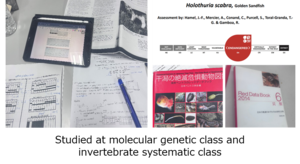
[Classes] Most of the classes I applied for were studying online and based on literature review. However, I was able to attend several on-side classes I interested myself "Invertebrate systematic" which shown how important to study on diversity with endanger species on IUCN Red list and only in Japan species discussion on how to plan for research them. I also took "Ecosystem Dynamics 1," which taught methods for studying the populations of marine species, specifically those of economic importance. Every class I attended was fulfilling and gave me further motivation for my future research as a marine biologist. |
 |
|
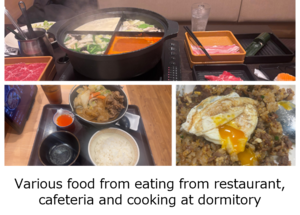
[Dormitory life & Daily meal] Dormitory life in Japan was very peaceful, convenient and comfortable. I learned how to cook various type of Japanese food such as Japanese fried rice, Gyu-don, Udon, Sukiyaki and Japanese curry rice. And sometimes I cooked Thai food which was enjoyable and tasty. Japanese food was also one of my favorite dishes, such as sushi, sashimi and grilled meat, they were surprisingly delicious when I tried in Japan. |
 |
|
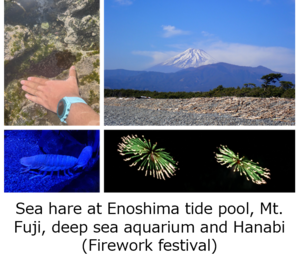
[Traveling] Since I am passionate about sea creatures, the places I visited most in Japan were aquariums. I observed unique marine animals that are rarely found in Thailand, such as deep-sea creatures and kelp forest organisms. Furthermore, I visited rocky beaches independently. These were incredible and much larger than the tide pools in Thailand. The size, diversity of animals, and the environment were vastly different from my own country. I was very excited to look closely and founs tiny organisms living on the rock surfaces. |
 |
|
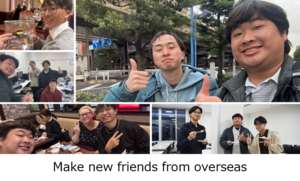
[Building Friendship] Fortunately, I was able to speak a little Japanese. Participating in activities with Japanese friends helped me gain a better understanding of the language. I was very impressed by their kindness; they openly engaged in conversation with me using both Japanese and English. In addition to Japanese friends, I also made many international friends from countries such as China, the USA, the Philippines, and Nigeria. Exchanging our cultures was a truly valuable. |
 |
|
[A Little message for next participations] For students who interest in OQEANOUS Plus Programs at TUMSAT, I suggest: Do not miss this precious opportunity to encounter new cultures, new things, new friends without any hesitation. However please note that prices in Shinagawa are quite high, including convenience stores, supermarkets and restaurants. I recommend HANAMASA Market, which is cheaper than nearby markets. |
