Overview
We conduct a wide range of research: analytical, observational and numerical modeling studies to understand atmospheric and oceanic phenomena, and theoretical research to establish advanced safety implementation systems for risk reduction.
Lecture Methods
We provide lectures on dynamical and thermodynamic processes associated with the structure, circulation, and variability of the atmosphere and oceans as well as their interactions, based on theory and observational data. The course covers various issues in achieving safety through risk reduction of safety-related systems, probabilistic and functional safety evaluation, and design of control systems to enhance reliability and safety.
Attractiveness
You can gain a physical understanding of various atmospheric and oceanic phenomena that affect our daily lives, such as fluctuations in ocean currents and sea surface temperature, low-pressure systems such as extratropical and tropical cyclones, and extreme weather events such as heavy rain, heavy snow, and strong winds. You will be able to analyze advanced risks and design control systems that enhance reliability and safety.
Staff
| Instructor | Title | Research Area | Course Title | |
|---|---|---|---|---|
| Fumiaki KOBASHI | Professor | Physical Oceanography, Air-Sea Interaction, Satellite Remote Sensing | Lecture on Environment Analysis Seminar on Environmental Sciences |
|
| Koichi SUYAMA | Professor | Control Engineering, Safety Engineering, Reliability Engineering | Functional Safety Engineering Fault-tolerant Control System Safety Experiment |
|
| Hidetaka HIRATA | Associate Professor | Meteorology, Air-Sea Interaction | Lecture on Environmental Predictions, Seminar on Environmental Sciences |
Selected Research Topics
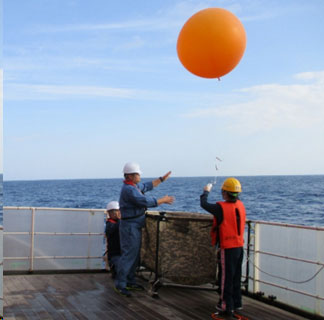
-
From comprehensive analysis of the data from marine meteorological observations, satellite observations, numerical models and other sources, we investigate the interaction between the atmosphere and the ocean and its mechanism.
(Prof. Fumiaki Kobashi and Assoc. Prof. Hidetaka Hirata)
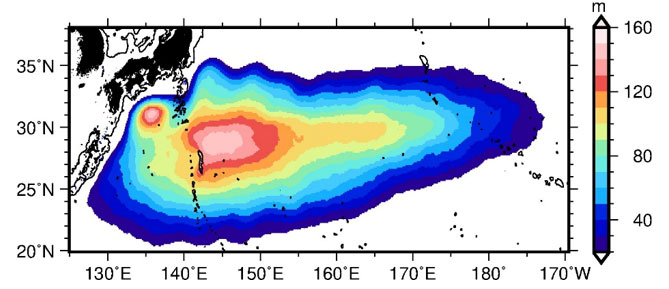
-
Focusing on the water mass called subtropical mode water which exists at depths of 100-300 m in a wide region from the south of Japan to near the date line, we examine its role in ocean circulation and climate. (Prof. Fumiaki KOBASHI)
Climatological mean thickness of the subtropical mode water based on an ocean reanalysis data.